
What is Place Building?
Place Building is about creating harmonious and enduring places rather than simply delivering housing numbers. It means creating walkable neighbourhoods with homes, workspaces, landscape, local identity and long-term stewardship integrated together.
Successful places are diverse, resilient and locally distinctive. They support community life, healthier lifestyles and stronger local economies. The Regional Building Foundation helps make this approach more scalable and achievable in practice.
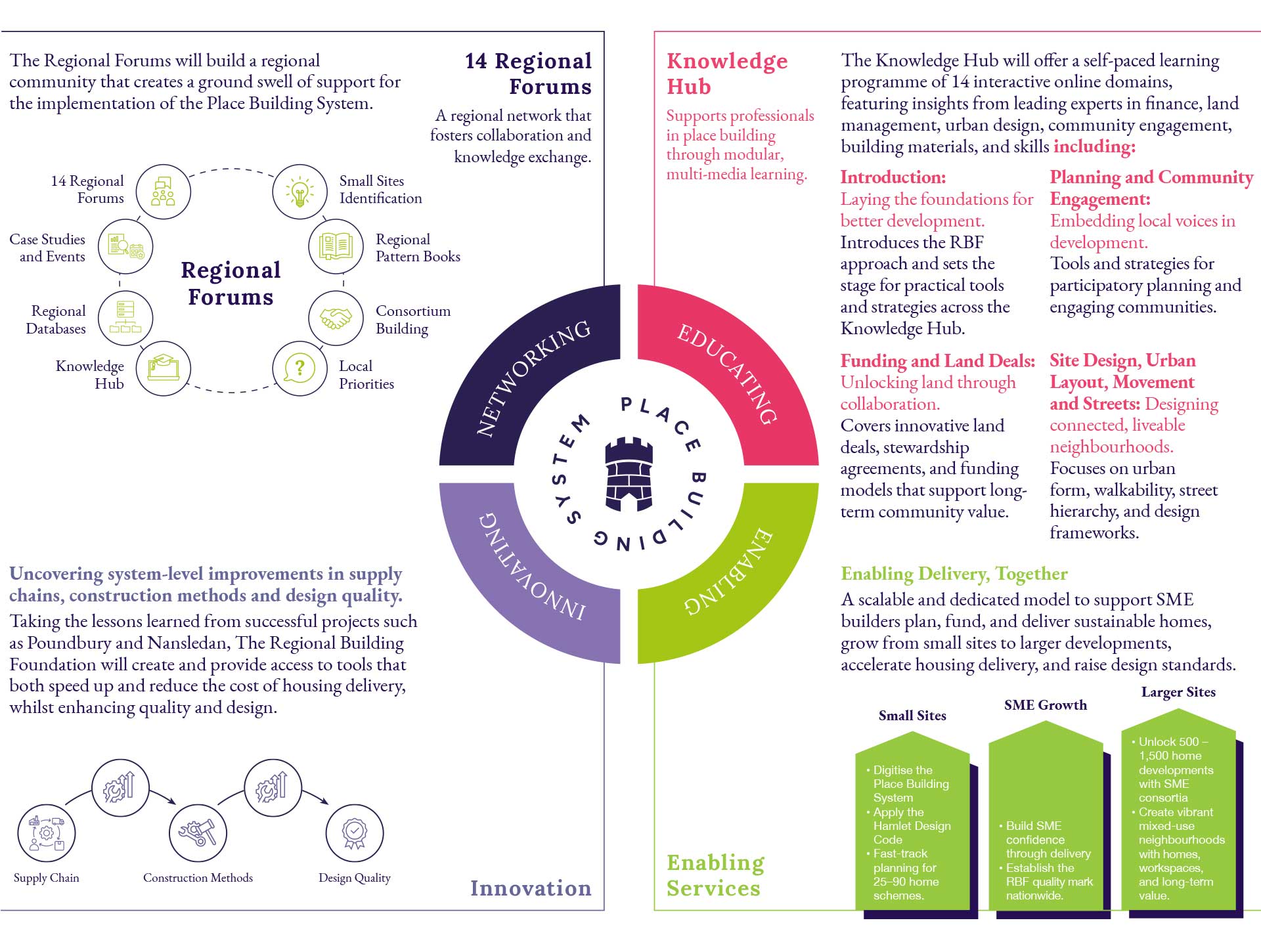
Together, the Regional Forums, Knowledge Hub and tailored Site Enabling Services will promote innovation, continuous learning and best practice sharing.
Our Place Building System
Why do we need Place Building?
The UK faces a chronic housing shortage. Although around 300,000 new homes are needed each year, delivery has repeatedly fallen short. The market is dominated by volume housebuilders, often producing uniform developments in poorly connected areas. These car-dependent neighbourhoods are linked to negative health outcomes, including obesity, heart disease, and mental health issues.
Our Approach to Place Building
The Regional Building Foundation’s approach to Place Building will focus on four key components:
Networking
Our 14 Regional Forums will bring together local stakeholders to grow a national movement and accelerate the implementation of the Place Building System.
Educating
Our Knowledge Hub provides practical, proven learning through a Place Building curriculum designed for regional developers, landowners and professionals.
Enabling
Helping regional developers plan, fund and deliver sustainable places, from small sites to larger developments. A scalable, dedicated model that supports regional developers and landowners to unlock sites, navigate complexity and deliver beautiful, viable places.
Innovating
Innovating construction, materials and design to deliver high-performance homes that reflect local identity.
Learning from successful projects such as Poundbury and Nansledan. The Regional Building Foundation will create and provide access to tools that both speed up and reduce the cost of housing delivery, whilst enhancing quality and design.
Increased walking and active travel
Designing walkable communities encourages residents to choose walking, cycling, and other forms of active travel, reducing reliance on cars.
Improved physical and mental health
Easy access to green spaces, safe pedestrian and cycle routes, and community facilities supports physical exercise and social interaction, which contribute to better overall health and wellbeing.
Reduced private vehicle use and lower emissions
Prioritising public transport, cycling, and walking, Place Building helps cut down on car journeys, leading to decreased air pollution and carbon emissions.
Stronger, more resilient communities
Well-designed, inclusive spaces support social cohesion, encourage pride within the community, and mutual support
Enhanced social mobility through better access to employment
Linking new housing with nearby employment opportunities and transport links opens up economic prospects for residents, facilitating social mobility.
Improved access to public services
Thoughtful planning ensures that healthcare, education, and other essential facilities are within easy reach for everyone within the community, reducing inequalities.
Greater housing diversity and opportunity
Supporting SME-led schemes encourages greater housing diversity and caters to a broader range of residents’ needs and incomes. In turn this helps create balanced and more inclusive communities.
Better quality of life for young people, the elderly, and lower-income households due to reduced car dependency
By enabling car-free travel, neighbourhoods are safer, with lower carbon emissions, helping to improve accessibility for vulnerable groups and boost quality of life and independence.
Reduces local opposition to development
By prioritising inclusive planning and community engagement, Place Building also reduces local opposition to development and fosters greater social cohesion
Why the ‘Place Building’ model can solve the housing crisis and build better communities
There is growing evidence to show that building mixed-use, walkable communities are better for the health, wealth and prosperity of communities across the country. Evidence also suggests strong demand for Place Building:
- Homebuyers want these homes: 72% of homebuyers prioritise access to walkable, green, and mixed-use neighbourhoods (URBED, 2020).
- Landowners show increasing interest in legacy-led, locally distinctive development models if low risk/viable.
- Regional Developers could scale from 15–25 to 125 to 450 homes/year with the right enabling support (FMB, 2020).
- Local authorities and communities seek integrated planning that delivers social, health, and environmental benefits and are dissatisfied with quality and design of new homes near them.
Click the image above to watch our video on Poundbury.
Walkability Index: Place Building vs House Building
Place building
Homes and workspaces, walkable, diverse, integrated, locally distinctive, regional builders.
- Source: Poundbury, Dorchester88%
House building
Just housing, car dependent, monocultural, anonymous, zoned, national builders.
- Source: Elvetham Heath, Hampshire4%
Place Building benefits both people and the planet by supporting healthier lifestyles, lowering emissions, and reducing infrastructure costs
Place Building in Action
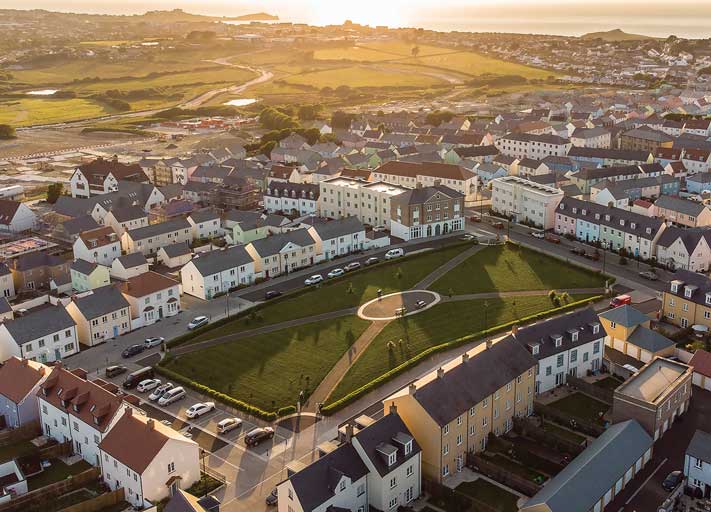
Successful examples like Poundbury and Nansledan show how thoughtful, human-centred design can increase property values and stimulate local economies. By fostering community pride, encouraging social connection, and reducing car dependency, Place Building aligns with national goals for more inclusive, resilient, and sustainable places.
1.2 million
Additional square metres of Green Space
Nansledan will provide an estimated 1.2 million square meters of natural and open space for the community, equivalent to around 180 full sized football pitches, and eight times Cornwall Council’s guidance on open space for a community of this size.
17.3%
of Poundbury residents commute to work on foot
That’s more than double the national average (7.6%). Fewer than half (42.6%) drive to work.
10
Home Energy rating
Every home in Poundbury has achieved the highest sustainability credentials, with BREEAM EcoHomes Excellent and National Home Energy rating.
35%
Affordable Housing
Poundbury consists of 35% mixed tenure affordable housing, almost double the national average of 18%, according to a 2025 study by Savills of 71 major housing developments.
100%
Supporting Local Economies
By 2028 Poundbury aims to accommodate 5,000 residents in 2,750 homes, while supporting around 2,730 jobs across 250 businesses, delivering roughly one local job for every home built.
The Place Building Framework
The RBF alongside the University of the Built Environment has developed a Place Building framework, based on the following core principles:
Community Participation
Involve local residents early to foster a sense of ownership and reduce opposition. Only 23% of UK adults feel they have a say in local decisions (Department of Culture, Media & Sport), Place Building ensures that community voices are integrated into decision-making, leading to greater support and cohesion.
Connectivity
Designing communities to support physical, digital and social connectivity. This encompasses transportation networks such as cycling routes and public transport systems to facilitate easy movement; information and communication technology infrastructure, and community organisations to foster greater social connections.
Design Quality
Prioritising high-quality design that influences how people interact with and connect with their environments. Well designed places are inviting, inclusive, promote walkability, social interaction and offer easy access to green space. Our framework supports buildings that reflect local culture and heritage and support local economies.
Environmental Resilience
Mitigating ecological impact and enhancing climate resilience to create communities that can adapt to long-term environmental changes. This involves using sustainable, regionally sourced materials and employing green building practices to reduce energy consumption and waste as well as lowering carbon emissions.
Governance
Fostering shared ownership among stakeholders, building trust and aligning interests through a long-term, regional vision. This ensures that developments reflect community aspirations and are resilient over time. Governance includes a commitment to stewardship, maintaining quality and functionality of places over time, and coordinating infrastructure and services to foster social cohesion.
Multi-Functionality
Integrating diverse uses by layering residential, commercial, civic, and ecological functions within adaptable spaces to reduce travel needs. Employing multi-functional design supports greater social interaction, strengthens economic resilience, and more efficient use of space. By accommodating people of all ages, abilities, and backgrounds, it also promotes greater inclusivity and long-term community vitality.
Place-based Economy
Supporting local economic development by leveraging local assets, skills, and identities to promote inclusive, sustainable growth. This bottom-up approach prioritises community-led solutions, participatory governance, and cross-sector collaboration. A prime example is Poundbury, with one job per home built and over 250 commercial spaces employing 2,730 people (Duchy of Cornwall, 2025).
Place Identity
Building on local history and culture to create communities with deep-rooted connections to the physical, cultural, and social environment. This approach fosters community pride, cohesion, and resilience, supporting sustainable development. Place identity is strongly linked to regional architecture and regionally-sourced materials. Inclusive and collaborative planning helps to ensure that diverse voices within local communities are heard.
Health, Wellbeing, and Education Outcomes
Prioritising health, wellbeing, and education through thoughtful design. Walkable, mixed-use communities with quality homes and green spaces support healthier lifestyles. Place Building addresses rural health inequalities by combining housing, jobs, services, and green infrastructure. Community involvement and fair investment reduce disparities, promote social mobility, and strengthen long-term economic resilience.